

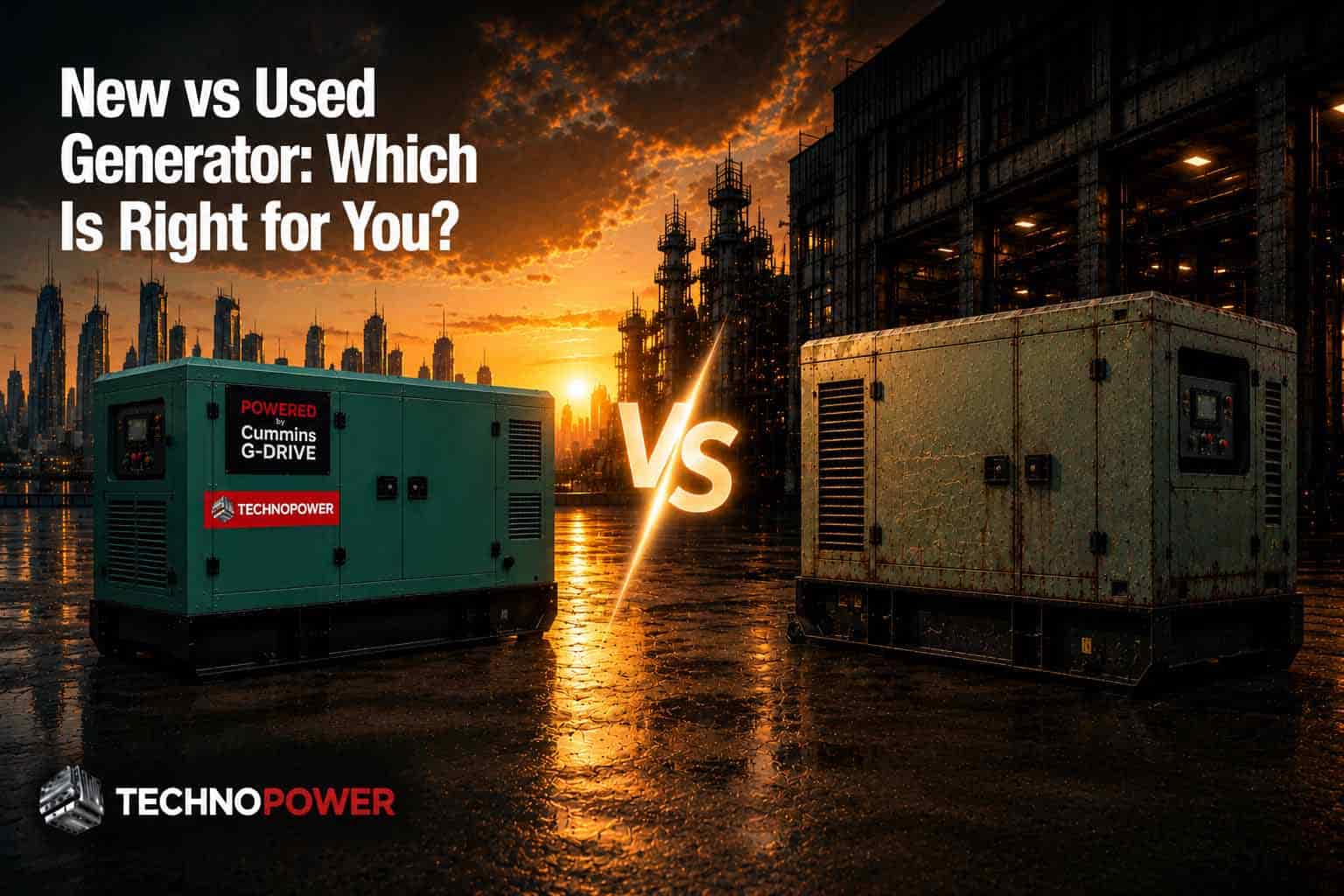
When your business, facility, or project depends on uninterrupted power, the generator you choose can make or break your operation. One of the most debated decisions buyers face is whether to invest in a brand-new unit or opt for a used generator at a lower upfront cost. But here's what most guides won't tell you: the real question isn't about price; it's about performance. This guide cuts through the noise and gives you a clear, data-driven comparison of new vs used generator performance, so you make the right call the first time.
1. What Generator Performance Actually Measures
Before comparing new and used units, it's important to understand what "performance" actually means in the world of diesel generators. Generator performance is not a single metric; it's a multi-dimensional profile that includes:
- Power output accuracy: Does the generator consistently deliver its rated kVA/kW under load?
- Voltage and frequency stability: Can it maintain a stable output without fluctuations?
- Fuel efficiency: How many liters per hour does it consume relative to its load?
- Transient response: How fast does it recover when a sudden load is applied or removed?
- Thermal performance: How well does it manage heat under continuous or peak operation?
- Emissions compliance: Does it meet the environmental standards required in your region?
Each of these metrics degrades differently in a used generator than in a new one, and understanding how they degrade gives you a major advantage when evaluating any unit.
2. Generator Performance Standards: Understanding ISO 8528-5
If you've ever seen a generator spec sheet packed with numbers and wondered what they actually guarantee, the answer lies in ISO 8528-5, the international standard that governs how generator sets are tested, rated, and reported.
What ISO 8528-5 Covers
ISO 8528-5 specifically defines the performance requirements for generating sets driven by reciprocating internal combustion engines. It sets the rules for:
- How voltage and frequency must behave under steady-state and transient conditions
- Acceptable limits for voltage dips and recovery times when a load is suddenly applied
- Permissible frequency deviations during load changes
- The conditions under which factory performance claims are validated
Why It Matters for New vs Used
A new generator from a reputable manufacturer comes with performance claims validated against ISO 8528-5 at the factory. The unit has been tested under controlled conditions before it ever reaches you. A used generator, however, may have originally been tested to this standard, but whether it still meets that standard after months or years of use is a completely different question. There is no mandatory recertification when a used unit changes hands, which means performance claims for used generators are largely unverified unless the seller can provide recent, independent load bank test data. Technopower Tip: Always ask for a current load bank test report before purchasing any used generator. If the seller cannot provide one, the unit's ISO 8528-5 compliance is unconfirmed.
3. How to Measure Generator Performance: The Metrics That Matter
Whether you're evaluating a new or used generator, performance measurement follows the same framework. Here's what to look for and how each metric is assessed:
Voltage Regulation
Measured as a percentage of deviation from nominal voltage under varying loads. A well-performing generator should maintain voltage within ±1% to ±2.5% of its rated output under steady-state conditions per ISO 8528-5 class G2 and above.
Frequency Stability
Frequency deviation is measured in Hz. Class G2 generators should hold frequency within ±2.5% during load changes. Anything wider suggests governor wear or fuel system issues, both common in aging used units.
Load Acceptance
This measures how the generator responds when a large load is suddenly connected. A healthy unit recovers quickly. A degraded unit, one with worn injectors, a tired governor, or a stressed alternator, will show excessive dips and a slow recovery curve.
Power Factor Performance
Generators are rated at a standard 0.8 power factor (lagging). Running a generator at a power factor far outside this range reduces effective output and accelerates wear. Used generators that have spent years running at poor power factors may show reduced alternator performance.
Fuel Consumption Rate
This is measured in liters per hour at a given load percentage (typically 25%, 50%, 75%, and 100% of rated load). New generators come with the manufacturer's fuel consumption curves. In used generators, actual fuel consumption often exceeds these figures due to injector wear, Generator air filter degradation, or compression loss.
4. New Generator Performance: Factory Ratings vs Real-World Output
There's a critical distinction every buyer should understand: nameplate ratings are not the same as real-world output.
What the Nameplate Tells You
A generator's nameplate lists its rated output, the power it can deliver under specific, controlled conditions (typically at sea level, 25°C ambient temperature, and a defined power factor). These conditions are rarely matched in the field.
Real-World Derating Factors for New Generators
Even a brand-new generator will deliver less than its nameplate rating when:
| Factor | Typical Performance Impact |
| High ambient temperature (e.g., 45°C in KSA) | Up to 10–15% power derating |
| High altitude installation | ~3.5% per 300m above sea level |
| Low power factor loads | Reduced effective kW output |
| Continuous vs. standby rating | Standby-rated units can't run 24/7 at full load |
Standby vs Prime vs Continuous Ratings
New generators are sold with clearly defined rating tiers:
- Standby (ESP): Maximum output for emergency use, limited hours per year at full load
- Prime (PRP): For variable load applications, can run indefinitely
- Continuous (COP): For constant load, 24/7 operation
Understanding which rating applies to your use case is essential. A generator sold as "500 kVA standby" may only be rated for "400 kVA prime", a significant difference for a facility that needs round-the-clock power.
5. How Performance Degrades in Used Generators Over Running Hours
This is where the new vs used comparison becomes concrete. Generator performance does not degrade uniformly; different systems deteriorate at different rates, and running hours are only part of the story.
The Running Hours Baseline
Industry consensus places the major service threshold for diesel generators at the following intervals:
- 500 hours: Oil, filters, minor inspection
- 1,000–2,000 hours: Injector inspection, coolant system check
- 5,000–8,000 hours: Major overhaul territory, injectors, turbocharger, and alternator brushes
- 15,000–20,000+ hours: Engine rebuild or replacement typically required
However, a generator with 5,000 hours that was well-maintained may outperform one with 2,000 hours that was neglected. Hours tell you age; maintenance history tells you condition.
Key Performance Degradation Points
Engine Compression Loss
As pistons, rings, and cylinder liners wear, compression drops. Lower compression means incomplete combustion, reduced power output, increased fuel consumption, and often visible exhaust smoke. This directly affects the generator's ability to meet its rated kVA.
Injector Wear
Worn fuel injectors deliver uneven fuel spray patterns, reducing combustion efficiency. The result: the generator consumes more fuel to produce the same output, if it can produce it at all.
Alternator Degradation
Insulation breakdown in the alternator windings is one of the most serious performance issues in used generators. It can cause voltage instability, reduced output, and in severe cases, complete alternator failure. Insulation resistance testing (using a megohmmeter) is essential before purchasing any used unit.
Turbocharger Fatigue
The turbocharger is responsible for forcing more air into the engine for better combustion. A worn turbo means less air, less power, and more smoke, and turbocharger replacement is not cheap.
Cooling System Degradation
Scale buildup, corroded hoses, and a worn water pump reduce cooling efficiency. A generator that cannot maintain safe operating temperatures will derate automatically or fail under sustained load.
6. The 20/20/20 Rule for Generators, And Why It Changes Everything
The 20/20/20 rule is one of the most practical and most overlooked guidelines in generator operation. It has a direct and significant impact on long-term performance, especially for used units.
What the 20/20/20 Rule States
The rule specifies that a diesel generator should not be operated at less than 20% of its rated load for more than 20 consecutive minutes, and should not run for more than 20 hours per year at very low loads.
Why Low Load Operation Damages Performance
When a diesel generator runs at very low loads (below 20–30% of rated capacity), the following problems develop:
- Wet stacking, Unburned fuel accumulates in the exhaust system, creating carbon deposits that restrict exhaust flow and reduce power output
- Glazed cylinder liners, Insufficient combustion pressure prevents piston rings from properly seating, causing oil to burn and compression to drop
- Injector fouling, Incomplete combustion leaves residue on injectors, degrading spray patterns over time
The New vs Used Implication
A new generator can be configured correctly from day one, sized appropriately for the load so it always runs in the efficient 60–80% load range. A used generator that spent its previous life chronically underloaded may already carry the accumulated damage of years of wet stacking and glazed liners, even if its running hours appear relatively low. This is why hours alone are a misleading indicator of condition. If you're evaluating a used generator, ask the previous operator about typical load levels. A unit that ran at 20–30% load for years may need a full engine deglaze before it performs reliably.
7. Performance Red Flags to Inspect in a Used Generator
Before committing to any used generator purchase, a thorough physical and operational inspection is non-negotiable. Here are the specific performance red flags that should give you pause:
Visual and Physical Inspection
- Exhaust ports: Black staining around exhaust ports indicates chronic rich running or injector problems
- Oil leaks: Leaks around the head gasket, turbocharger seals, or injection pump suggest deferred maintenance
- Coolant condition: Brown or rusty coolant indicates a neglected cooling system with scale buildup
- Alternator housing: Cracks, corrosion, or evidence of moisture entry are serious warning signs
- Wiring condition: Brittle, damaged, or improperly repaired wiring is a reliability and safety concern
Operational Test Red Flags
- Excessive smoke on startup: White smoke (unburned fuel or coolant) and black smoke (rich mixture/air restriction) both indicate problems
- Slow load pickup: A healthy generator accepts load quickly and smoothly. Sluggish response suggests governor or fuel system issues
- Voltage hunting: Unstable voltage that fluctuates under constant load points to AVR problems or alternator wear
- Unusual vibration or noise: Knocking, rattling, or abnormal vibration can indicate bearing wear, loose mounts, or internal engine damage
- High oil consumption: If the unit needs oil top-ups more than expected, piston rings or valve seals are likely worn
Documentation Red Flags
- No maintenance logbook or service records
- Missing or altered hour meter readings
- No load bank test data from the past 6–12 months
- Unclear ownership history or generator provenance
8. New vs Used: Side-by-Side Performance Comparison
Here is a direct performance comparison across the metrics that matter most:
| Performance Metric | New Generator | Used Generator |
| Rated Output Accuracy | Meets manufacturer spec at delivery | Maybe 10–30% below nameplate due to wear |
| Voltage Stability | ISO 8528-5 certified at the factory | Depends on alternator condition, unverified |
| Fuel Efficiency | Matches manufacturer's consumption curve | Typically, 10–25% higher fuel consumption |
| Transient Response | Fast load acceptance per spec | May show slow recovery, dips, hunting |
| Reliability (First Year) | High, covered by warranty | Variable, depends entirely on history |
| Emissions Compliance | Meets current Tier/Stage standards | May not comply with current regulations |
| Maintenance Cost (Year 1) | Low, standard scheduled maintenance | Potentially high, deferred work, unknown issues |
| Expected Service Life | Full manufacturer-rated life remaining | Reduced, proportional to hours and condition |
| Documentation | Complete factory spec and warranty | Often incomplete or missing |
| Customization | Available from the factory | Limited to the existing configuration |
9. Which Delivers Better ROI, New or Used Generator Performance?
The used generator's lower purchase price is compelling, but ROI is calculated over the full lifecycle of the asset, not just at the point of purchase. Here's how to think about it:
When a New Generator Delivers Better ROI
- Mission-critical applications, Hospitals, data centers, telecom towers, and industrial facilities where downtime has a direct financial or safety cost cannot afford the unpredictability of a used unit
- Long-term projects: If you need reliable power for 5+ years, a new generator's full service life and warranty protection typically deliver lower total cost of ownership
- Emissions-sensitive environments: New generators meet current Tier 4 or equivalent emission standards; older used units may face regulatory restrictions or bans in certain regions
- Remote or unmanned sites, where service response is slow, and downtime is expensive, reliability is paramount
When a Used Generator Can Make Financial Sense
- Short-term or temporary applications, Construction sites, events, or projects with a defined endpoint, where you don't need the unit long-term
- Budget-constrained situations, where capital expenditure is strictly limited, and the unit will be closely monitored
- Well-documented, low-hours units: A used generator from a reputable source with full service records, recent load bank test data, and a short runtime history (under 5,000 hours on a major brand engine) can offer genuine value
- Backup redundancy, as a secondary or tertiary backup unit, where another generator provides primary reliability
The Hidden Costs of Used Generators
When evaluating a used generator ROI, account for:
- Deferred maintenance on purchase (injectors, filters, coolant system flush, alternator inspection)
- Increased fuel costs from reduced efficiency
- Higher probability of unplanned downtime and emergency repair costs
- Shorter remaining service life before major overhaul is required
- Potentially limited or no warranty protection
The honest calculation: A used generator priced at 40% of a new unit's price is only a bargain if its total lifecycle cost, including fuel, maintenance, downtime, and earlier replacement, remains below the new unit's lifecycle cost. In many critical applications, it doesn't.
10. FAQs: Generator Performance, New vs Used
How to measure generator performance?
Generator performance is measured through a combination of electrical testing and operational monitoring. The primary method is load bank testing, where a controlled resistive, inductive, or reactive load is applied to the generator at defined percentages of its rated capacity (typically 25%, 50%, 75%, and 100% load). During this test, engineers measure and record voltage output, frequency, fuel consumption rate, exhaust temperature, oil pressure, coolant temperature, and transient response (how quickly the unit recovers from sudden load changes). For a used generator, insulation resistance testing of the alternator windings using a megohmmeter is also essential. These measurements are then compared against the manufacturer's published performance curves and the tolerances defined in ISO 8528-5.
What is the 20/20/20 rule for generators?
The 20/20/20 rule is an operational guideline stating that diesel generators should not be run at less than 20% of their rated load for more than 20 consecutive minutes, and should be limited to no more than 20 hours of very low load operation per year. The rule exists because chronically underloaded diesel generators develop serious internal problems, primarily wet stacking (unburned fuel accumulating in the exhaust system) and glazed cylinder liners, that progressively degrade performance and reliability. Adhering to this rule means sizing your generator correctly for your actual load and ensuring that during low-demand periods, the unit is either switched off or run up to an adequate load periodically for burn-off.
What is ISO 8528-5?
ISO 8528-5 is the section of the international ISO 8528 standard series that specifically covers the performance requirements for AC generating sets. It defines the classes and tolerances for voltage regulation, frequency regulation, and transient response that generator sets must meet under various load conditions. The standard classifies generators into performance classes (G1 through G4), with G1 being the most basic and G4 the most demanding. Most commercial and industrial generators are sold to G2 or G3 class specifications. ISO 8528-5 is the reference framework that manufacturers use when publishing generator performance data, and it is the standard against which load bank test results are evaluated.
Generator Performance Standards
Beyond ISO 8528-5, generator performance is governed by several overlapping standards depending on application and region:
- ISO 8528-1 to 8528-13: The full family covering everything from definitions and ratings to control systems, safety, and test methods
- IEC 60034: Standards for rotating electrical machines, including alternators
- EPA Tier 4 / EU Stage V: Emissions performance standards that define acceptable exhaust output for diesel engines, relevant for both new and used generators in regulated environments
- NFPA 110: The standard for emergency and standby power systems, widely referenced for hospital, data center, and life safety generator installations
- BS 7671 / IEC 60364: Electrical installation standards that govern how generators are connected to building power systems
For operations in Saudi Arabia, the UAE, and across the Middle East, compliance with both international standards and local regulatory requirements (SASO, DEWA, and similar bodies) must be verified for any generator, new or used. Technopower specializes in high-performance diesel generator solutions across Saudi Arabia, the UAE, and the wider Middle East. Our technical team provides load bank testing, performance verification, and expert guidance to help you select the right generator for your exact requirements, whether new or used.


