

In every power grid, voltage is the pulse of good performance. Low voltage in a generator can disrupt entire operations, from factory machinery and light systems to data centers and household power supply. Low voltage not only reduces efficiency but also ruins sensitive electrical equipment.
Techno Power, a trusted power generation solutions provider in the Middle East and Africa since 2008, has years of experience in diagnosing and resolving low voltage issues. From diesel generators to synchronization panels and Deep Sea controllers, our technical support ensures your power systems provide stable, reliable output, anywhere, anytime.
Why Generator Low Voltage Is a Critical Issue
A low-voltage generator is more than an annoyance; it's a productivity and safety hazard.
The Impact of Low Voltage on Electrical Equipment
Low voltage causes motors to draw more current, which leads to overheating and insulation breakdown. Lighting systems flicker or become dim, control circuits collapse, and equipment performance drops. In industrial applications, the result can be catastrophic, including cut production, downtime, and costly repairs.
Business and Operating Expenses
For factory and commercial facilities, a few seconds of unstable voltage can trigger shutdowns. Over the long term, the instability decreases equipment life, increases maintenance costs, and impacts profitability. That is why routine testing and expert service are essential.
Technical Overview: What Causes Generator Low Voltage
Generator low voltage can be the consequence of many mechanical, electrical, or environmental factors. Identifying the root cause is the key to successful repair.
Weak Excitation or Failure of AVR
The AVR controls the excitation system of the generator. If the AVR is defective, not correctly adjusted, or damaged, then the field current of the generator gets weak, resulting in low voltage. Regular testing and calibration are a must.
Faulty or Worn Brushes and Slip Rings
In brush alternators, dirty or worn brushes create high resistance and reduce current flow, and thus low voltage. Cleaning and replacement as a preventive maintenance remedy eliminates this.
Engine Speed Instability or Fuel Problems
Voltage output is directly proportional to the speed of the generator. Voltage will be down if the engine is running below rated RPM due to fuel contamination, choked filters, or malfunctioning of governors. Techno Power field engineers check these conditions on every service visit.
Loose Connections or Undersized Cables
Poor wiring, corroded terminals, or undersized cables cause voltage drops between the alternator and the load. Proper cable size and tight connections are easy but important preventive remedies.
Environmental and Load Factors
High ambient temperatures, humidity, or non-linear loads (such as variable frequency drives) also cause unstable voltage output. Smart monitoring systems can detect and compensate for them.
Recognizing the Signs of Generator Low Voltage
Early detection will prevent costly downtime.
Flickering Lights and Equipment Failure
When lights flicker, motors slow down, or delicate electronics behave strangely, voltage may be lower than the rated output.
Alarm or Fault Codes in Control Panels
State-of-the-art controllers like Deep Sea Electronics (DSE) models provide instant feedback as alarms and fault codes. Techno Power, as a golden distributor of DSE products, helps customers decode and resolve these notifications effectively.
Generator Low Voltage Testing
A methodical testing procedure yields accurate results and safe troubleshooting.
Pretest Safety Checks and Preparation
Before the test, isolate the generator from the load, verify grounding, and employ protective gear. Verify that all circuits are safe to access.
Measurement of Output by a Multimeter
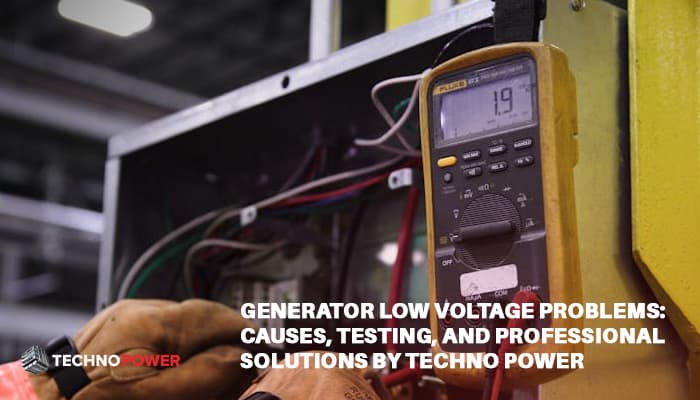
Measure the voltage on the generator terminals with no load and load connected. Compare against rated nameplate values.
Load Bank Testing
Through simulating real electrical loads, load bank testing will determine if the generator is voltage stable under load. Techno Power's UAE and Saudi Arabia service centers perform such tests regularly for clients.
AVR and Excitation Circuit Testing
Inspect wiring to the AVR, verify polarity and insulation, and check excitation voltage. Adjust or replace the AVR if readings fall below specification.
Corrective Actions for Generator Low Voltage
Upon identifying the reason, careful repairs reestablish system integrity.
AVR Adjustment or Replacement
Reset the voltage setpoint following the manufacturer's guidelines. Replace with genuine parts if defective. Techno Power provides genuine Deep Sea and FPT parts.
Brushes & Slip Rings Cleaning and Replacement
Brush carbon deposits and check brush tension. Replace brushes when below the minimum wear limit.
Engine Tuning and Governor Calibration
Verify RPM with a tachometer and adjust governor for steady rated speed (usually 1500 or 1800 RPM). A quality governor delivers stable voltage.
Optimizing Electrical System
Verify and upgrade cables, exchange rusty connectors, and improve grounding to reduce voltage drops.
Preventive Maintenance Practices
Periodic Testing Schedule
Monthly: No-load testing and visual inspection
Quarterly: Load bank test and AVR setting
Yearly: Full system audit, engine tuning, and cable testing
Role of Data Logging and Remote Monitoring
Smart controllers keep records of voltage trends, and engineers can foresee and prevent failures using them. Such monitoring is built into the installations of Techno Power.
Expertise of Techno Power in Voltage Stabilization
Deep Sea Control Systems and Synchronization Panels
Techno Power integrates DSE controllers and synchronization panels that regulate generator output with precision. Such systems maximize load distribution and stabilize voltage even in complex multi-generator systems.
Field Testing and Commissioning Services
From Dubai to Sudan, Techno Power engineers conduct field testing, ensuring that all generators are voltage stability compliant before commissioning.
Frequently Asked Questions (FAQ)
Q1: What constitutes low voltage for a generator?
A1: Any output voltage 10% less than the rated voltage (e.g., less than 360 V for a 400 V generator) is low and requires inspection.
Q2: Will low voltage hurt connected equipment?
A2: Yes. Low voltage causes motors to take greater current, resulting in overheating, insulation deterioration, and decreased efficiency.
Q3: Is it okay to run a generator with low voltage?
A3: No. Low voltage for prolonged periods will cause permanent damage to the generator and load.
Q4: How do I prevent low voltage?
A4: Proper maintenance, AVR calibration, engine speed testing, and correct cabling and grounding.
Q5: Does Techno Power offer onsite voltage testing?
A5: Yes. Our engineers across the UAE, Saudi Arabia, Qatar, and Africa perform thorough voltage and load bank testing for our clients.
Q6: In what way is AVR applied to avoid low voltage?
A6: The Automatic Voltage Regulator adjusts field excitation to maintain constant output voltage in the event of load change.
Conclusion: Stable Voltage, Reliable Power
A generator low voltage issue has the potential to undermine business continuity and safety. With knowledge of the causes, preventive maintenance, and faith in experts like Techno Power, you are guaranteed safe power transmission in all your activities.
Over 15 years of industry experience, Techno Power is your reliable business partner for generator testing, maintenance, and voltage stabilization.
Contact Techno Power immediately:
Email: support@technopowergroup.com
Phone: +971 559 813 463


