

Electricity is no longer a luxury in this day and age; it's a lifeline. Power continuity is all that counts, from Abu Dhabi building sites to Dubai data centers.
Here's the truth, however: even the best generator has limitations. When power needs exceed one unit's capacity, efficiency levels suffer, fuel is wasted more, and the risk of failure becomes higher.
That is where generator load sharing steps in, a smart, coordinated one that allows multiple generators to be a unified system, loading the electrical burden intelligently and seamlessly.
It's not labor division; it's efficiency, stability, and reliability, the three pillars of modern energy management, especially in a place like the UAE, where 24/7 power supply drives progress.
What Is Generator Load Sharing?
Simply put, generator load sharing refers to linking two or more generators in a way that they operate in parallel, apportioning the overall electrical load between them as per their capacity.
Suppose two individuals are lifting a heavy box. If they synchronize, lifting becomes easier, and they go faster. However, if one does more than the other, balance is disrupted, and that's precisely how generators also act.
With load sharing, two or more gen-sets share data from synchronizing panels or load-sharing controllers and automatically regulate their output to stabilize and balance.
How Load Sharing Works – The Technical Side Simplified
When generators operate in parallel, several critical parameters must be synchronized: Voltage, Frequency (Hz), and Phase angle.
When synchronization has been achieved, every one of the generators supplies a proportionate percentage of power kW (active power) and kVAR (reactive power) to the total load.
The control system ensures that: The load is proportionately distributed based on generator capacity, No generator becomes overloaded, and All units are run at their optimal fuel economy.
In modern systems, controllers like Deep Sea, ComAp, or Woodward do this automatically, adjusting fuel supply, excitation, and governor control in real time.
Types of Load Sharing
kW Load Sharing: Distributes real (active) power between generators - Common Application: Industrial, commercial power systems.
kVAR Load Sharing: Balances reactive power for voltage stability - Common Application: Large facilities, hospitals, and data centers.
Isochronous Load Sharing: All generators share the load equally, regardless of speed variation - Common Application: Critical backup systems.
Droop Load Sharing: Each generator carries a load according to its frequency droop setting - Common Application: Simpler or older setups.
Every system is different based on power network size, layout, and usage.
Real-Life Application: A Power System for a Hotel in Dubai Marina
Consider a five-star hotel in Dubai Marina. It cannot risk even one second of blackout of elevators, air conditioning, lights, kitchen appliances, and everything depends on electricity.
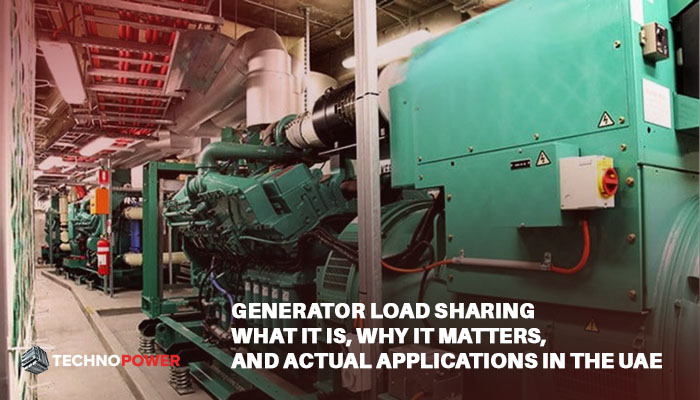
Instead of a single large generator, the hotel uses three medium-capacity diesel generators operating in parallel. One runs under normal conditions to cater to the minimum requirements. When the occupancy is high or AC load increases, the second and third units come on automatically, synchronizing in a few seconds.
They communicate with one another through a load-sharing panel, varying output smoothly. During nighttime when demand is less, one generator shuts off to save fuel.
Result? Uninterrupted, constant power and optimum fuel efficiency, all thanks to load sharing.
Benefits of Load-Sharing Generators
1. Greater Efficiency
Running multiple generators only when needed prevents overloading and wasteful fuel waste. Every generator is running at its highest efficient load, extending lifespan and reducing emissions.
2. Expandability
Need more power? Add another generator to the system. Load sharing allows expandability in flexible increments without redesigning the overall system.
3. Redundancy and Reliability
When a single generator fails, others cover the load immediately, with no downtime. That's crucial for the UAE's hospitals, banks, and telecommunication centers.
4. Fuel Savings
Rather than running one huge generator at reduced load (fuel wastage), load sharing uses only the required capacity, which translates into up to 20% savings in fuel.
5. Maintenance Flexibility
Generators can be taken offline for maintenance without compromising the power supply, since the others will share the load.
6. Longer Equipment Life
Balanced operation means less wear and tear, fewer engine stress points, and longer service intervals.
How Load Sharing Functions in Diesel Generators
Diesel generators are applied most extensively in the UAE industries, villas, and business premises. This is the way load sharing typically happens:
Synchronization: The system synchronizes frequency, phase, and voltage.
Parallel Operation: Generators are on a common busbar.
Active Power Distribution: Output-sensing load-sharing controllers adjust engine throttle or fuel rack accordingly.
Reactive Power Distribution: Voltage is regulated by excitation control.
Monitoring and Adjustment: The System constantly keeps the load balanced, preventing overload or underload.
New generator sets from Perkins, Cummins, to take a few examples, typically come pre-equipped with smart controllers with parallel operation, and integration gets an even smoother ride than before.
Automatic vs Manual Load Sharing
Automatic Load Sharing: Uses digital controllers to manage load balance automatically - Best For: Industrial & commercial facilities.
Manual Load Sharing: The operator adjusts the load manually using switches or throttles - Best For: Small-scale or temporary setups.
In the UAE, auto load sharing comes first due to reliability and safety, most especially in mission-critical environments such as data centers or airports.
Load Sharing in Hybrid Generator Systems
Due to the popularity of renewable energy in the UAE, many companies use hybrid systems where diesel generators are combined with solar panels or batteries.
In such cases, load sharing acquires a different meaning. The system doesn't just share load between the generators but shares power between diesel, solar, and battery sources as well, to maximize efficiency.
Example: During the daytime, solar panels take care of most of the load. The generator runs at low load or is idle. After sunset, the load is shared by the batteries and the generator automatically, with a hybrid controller in control.
Challenges in Load Sharing Systems
The finest systems are susceptible to problems if not configured correctly:
Incorrect Synchronization Settings: Frequency mismatch may cause backfeeding or generator tripping.
Uneven Load Distribution: Caused by faulty sensors or calibration errors.
Communication Failures: Faulty controllers or faulty data cables may cause communication disruption between gen-sets.
Environmental Factors: Sand, temperature, and humidity in the UAE tend to affect sensors and wires.
Improper Grounding or Cabling: Causes unsafe operation and electrical imbalance.
These problems demonstrate the justification for professional installation and periodic examination.
Preventive Maintenance of Load-Sharing Systems
To keep load-sharing systems in good running order: Check load-sharing cables regularly for corrosion or wear. Clean and inspect control panels monthly. Verify governor and AVR (Automatic Voltage Regulator) calibration annually. Do load tests periodically every several months. Verify cooling systems' operation, especially in hot and dry environments. Train operators to recognize symptoms of load imbalance early on.
Preventive maintenance in the UAE climate can be the difference between uninterrupted power and costly downtime.
Smart Load Sharing and the Future of Power Management
The new controllers take load sharing to new levels, with: Remote monitoring (IoT-based), Automatic scheduling, Fuel consumption measurement, and Real-time performance alerts.
With smart load management, UAE facility managers are able to monitor generator performance from a smartphone, even remotely start or stop units.
This isn't the future, it's already a habit in industrial parks, hospitals, and data centers across the Emirates.
FAQs – Generator Load Sharing
Q1: Load sharing and load shedding are different. What is the difference?
Load sharing distributes power between generators; load shedding intentionally reduces power to prevent overload.
Q2: Can generators of different sizes share load?
Yes, as long as controllers are properly configured, each generator will share the load according to its rated capacity.
Q3: Is load sharing applicable only for big systems?
No, even extremely small firms with two generators have the facility for load sharing to be efficient and reliable.
Q4: What if one of the generators breaks down?
The other ones take up the load automatically, and the failed unit safely disconnects.
Q5: Do load-sharing systems conserve fuel?
Yes, typically 10–20%, because only the capacity that's needed operates at any given time.
Q6: Is it possible to retrofit load sharing into my existing generator setup?
Yes, through suitable synchronization and controller panels, any diesel generators can be retrofitted.
Powering the UAE with Smarter Energy
In a city that never sleeps, generator load sharing is quietly powering progress, from Dubai cityscapes to Al Ain farms.
It's the behind-the-scenes collaboration that illuminates lights, cools data centers, and builds never sluggish.
By sharing the load wisely, generators not only save fuel but also save time, finances, and offer dependability in every facet of UAE life.
As technology continues to progress, load sharing will remain the foundation of smarter, cleaner, more resilient energy systems, built for the desert, made for the future.


